The Book of Revelation in British Scholarship
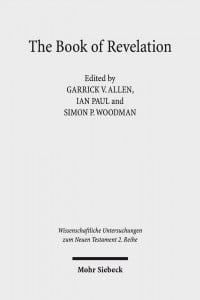 For ten years, from 2005 to 2014, I chaired the Revelation seminar at the almanac British New Testament Briefing. During that fourth dimension, we quickly doubled the number of papers presented at each conference from three to half-dozen, so that in the 10 years we heard more than l papers. They ranged from initial thoughts from those early on in their PhD research to the mature reflections of established scholars, and a couple of years ago I thought it would be good to collect the best of these into a book. (Steve Moyise, who established the group and led it for its first seven years, had done something similar, and this produced the volumeStudies in the Book of Revelation to which I contributed.) The end result is out next calendar month, edited with Garrick Allen and Simon Woodman, and published by Mohr Siebeck in the prestigious WUNT Ii series.
The book indicates the continued lively interest in Revelation in British inquiry and study, simply also the kinds of questions—some new, some long-established—that go on to be asked about the text. These include:
- How and why does Revelation reuse the language and imagery of the OT?
- What is the affective ability behind its metaphorical language?
- Why is information technology such a discontinuous text, and does this suggest that it was a composition from earlier fragments?
- How do we respond to the language of judgement in the book?
- How practise we make sense of its genre, when it is dissimilar the other 'apocalyptic' texts to which it lends its name?
- How have its images of violence been read in the past, and how should nosotros read them?
- What is its relation to early on Christian ideas of martyrdom?
- How is information technology shaped by its historical context, and in particular elements of Roman majestic ceremony?
- And how has the text shaped and influenced prophetic and renewal movements?
These are not the just questions to inquire, simply they are ones of abiding significance and fascination. I give the total contents list below. The book is completed with a lively response from Steve Moyise. He concludes:
I only have infinite to comment on a couple of points of interest in these engaging and well-researched essays. The first is the emphasis on visualisation, not only through Christopher Rowland's discussion of Blake'southward artwork merely also his discussion of Mary Carruthers, who argues that the "monastic do of meditation notably involved making mental images or cerebral 'pictures' for thinking and composing." Information technology made me wonder if I was wrong to suggest that Allen's proposal concerning the consonantal Hebrew text turns John into a scribe or rabbi instead of a visionary prophet. Maybe we should view information technology more as a visual action, where the actual shapes and patterns of the Hebrew text formed new patterns in his altered state of consciousness. There is more than to the word "run into" than meets the eye!
Second, modern scholars try to employ sure criteria to decide if an allusion or echo is intended but they are at a considerable disadvantage to those who throughout their lives have used the biblical texts for prayer, singing, discussion, preaching, meditation and even as a source of visionary experience. Some of their suggestions may seem to have little foundation in the text but this might exist because the connections are now subconscious from us. The starting point for many studies today is the list of parallels in the margins of Nestle-Aland but a reception history of the passage could usefully supplement this.
Lastly, reception history forces u.s.a. to inquire the question: What does it mean to say that a book similar Revelation is inspired? Is it saying something about the origins of the book, such as whether John was genuinely in touch with God or just suffering from an over-agile imagination? Is information technology offering some sort of guarantee for the final product, for case, that it is gratuitous from the vindictiveness or gender stereotyping that we see in similar works? Or is information technology saying something about the effects of the book, that it can inspire readers and hearers to acts of backbone and cocky-giving? Some readers of this collection may have definite views on this just questions can be asked of all three. Do nosotros actually want to maintain a dichotomy between inspiration and imagination? Tin can the aforementioned words and sentiments be free from vindictiveness in one writing (Revelation) but not in another (i Enoch)? Has not the book been used to justify violence and bigotry as much every bit it has inspired courage and cocky-giving? When I began my doctoral studies on Revelation in 1987, someone said to me that the value of focusing on Revelation is that all of the hermeneutical issues raised by the New Attestation are present in Revelation – only more so! Information technology is perhaps why the book remains endlessly fascinating, every bit this fine collection of essays demonstrates.
His last comment exactly matches my reasons for doing my own PhD on Revelation. At £lxx or and then when published, this volume might not exist offset on your Christmas list—just do rail it down in a library near yous. And I will proceed to write here on some of the issues that it raises.
Contents
Text, Structure, and Persuasion
Garrick Five. Allen: Reusing Scripture in the Book of Revelation: Techniques of Reuse and Habits of Reading
Andrew Harker: Prophetically Called Sodom and Egypt: The Affective Power of Revelation 11.ane–13
Ian Paul: Source, Structure, and Limerick in the Book of Revelation
Context, Estimation, and Genre
Richard Bauckham: Judgment in the Book of Revelation
Sarah Underwood Dixon: 'The Testimony of Jesus' in Light of Internal Self-References in the books of Daniel and 1 Enoch
Sean Michael Ryan: 'The Testimony of Jesus' and 'The Testimony of Enoch': An emic Approach to the Genre of the Apocalypse
Michelle Fletcher: Apocalypse Noir: How Revelation Defined and Defied a Genre
Ronald Herms:Pneumatikos and Antagonists in Revelation 11 Reconsidered
W. Gordon Campbell: Facing Fire and Fury: I Reading of Revelation's Violence in the Context of Recent Estimation
Simon P. Woodman: Burn down from Heaven: Divine Judgment in the Book of Revelation
Paul Middleton: Male person Virgins, Male Martyrs, Male person Brides: A Reconsideration of the 144,000 'who have non dirtied themselves with women' (Revelation fourteen.4)
Shane J. Woods: God's Triumphal Procession: Re-examining the Release of Satan in the Light of Roman Imperial Imagery
Reception
Christopher Rowland: British Interpretation of the Apocalypse: A Historical Perspective
Ian Boxall: The Mighty Angel with the Little Gyre: British Perspective on the Reception History of Revelation 10
Jonathan Downing: The Women Clothed in the Sun: The Reception of Revelation 12 among Female British Prophets 1780–1814
Afterword
Steve Moyise: A Response to Currents in British Research on the Apocalypse
Follow me on Twitter @psephizo
Much of my piece of work is washed on a freelance basis. If y'all have valued this mail service, would yous consideraltruistic £1.twenty a month to back up the production of this blog?
If you enjoyed this, do share information technology on social media (Facebook or Twitter) using the buttons on the left. Follow me on Twitter @psephizo. Like my page on Facebook.
Much of my piece of work is done on a freelance basis. If you accept valued this mail, you can brand a unmarried or repeat donation through PayPal:
For other means to support this ministry, visit my Back up page.
Comments policy: Good comments that engage with the content of the postal service, and share in respectful argue, can add real value. Seek get-go to understand, and then to be understood. Make the most charitable construal of the views of others and seek to learn from their perspectives. Don't view debate equally a conflict to win; address the argument rather than tackling the person.
Source: https://www.psephizo.com/reviews/the-book-of-revelation-in-british-scholarship/

Postar um comentário for "The Book of Revelation in British Scholarship"